
In the global pursuit of reliable, scalable, and cost-effective renewable energy, one persistent challenge continues to confront engineers, governments, and investors alike: how to store energy efficiently for use when it is needed most. While solar and wind generation continue to expand rapidly, their intermittent nature creates a fundamental imbalance between supply and demand. Into this gap steps a deceptively simple yet potentially transformative innovation—the sand battery.
Recent developments in Finland, led by Polar Night Energy, are pushing this concept further than ever before. Their latest project aims not only to store energy as heat but to convert that stored heat back into electricity—effectively closing the loop and creating a full power-to-heat-to-power system. This advancement represents a critical step toward solving one of the most pressing issues in renewable energy adoption.
This article explores the science, engineering, advantages, challenges, and future implications of sand battery technology, with a clear, professional lens grounded in real-world application and long-term viability.
Understanding the Sand Battery Concept
At its core, a sand battery is a thermal energy storage system. Rather than storing electricity directly—as is the case with lithium-ion batteries—it stores energy in the form of heat.
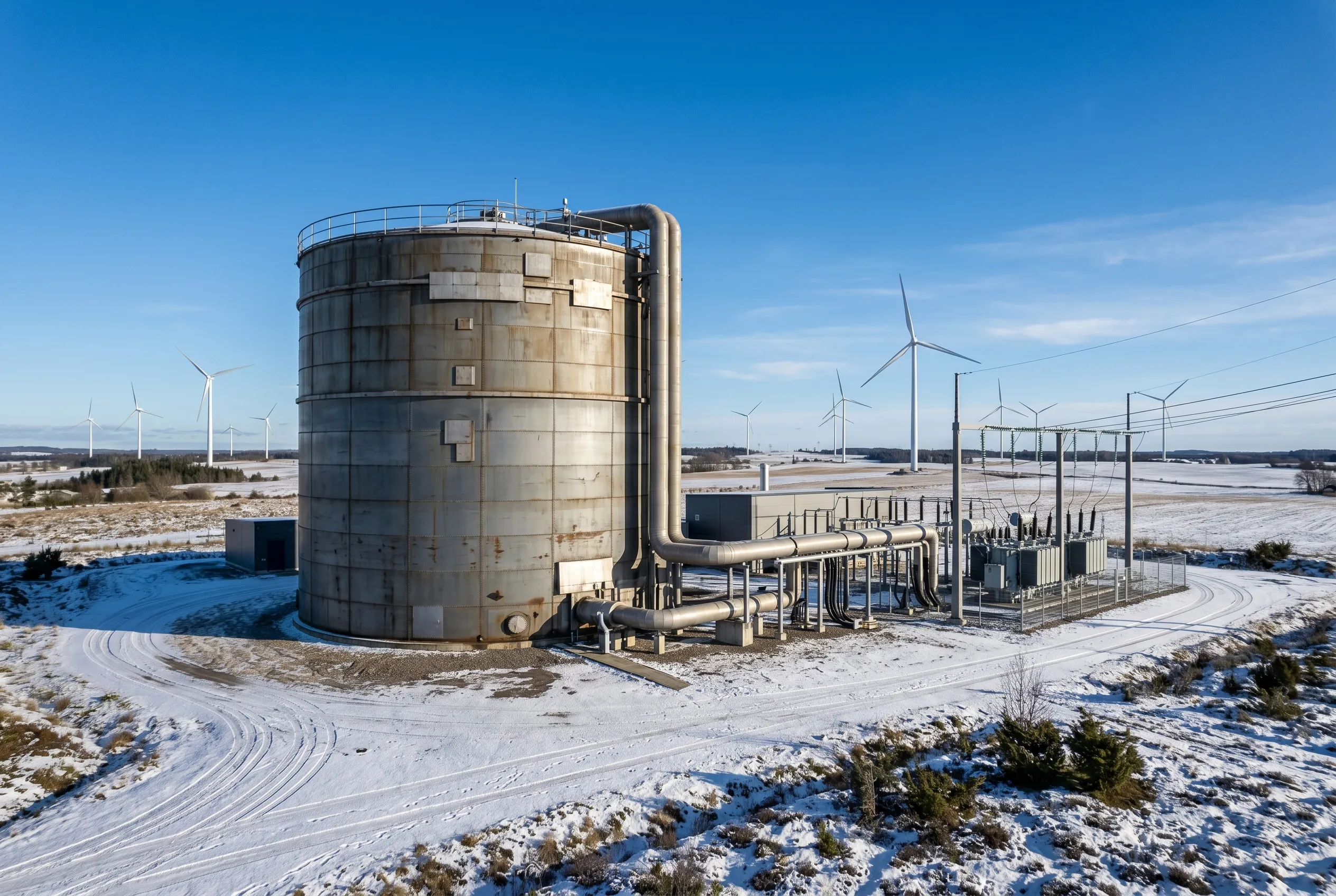
The process is straightforward in principle: Electricity generated from renewable sources is used to heat a large volume of sand or similar granular material. The sand is contained within a well-insulated silo, allowing it to retain heat for extended periods. When energy is required, this stored heat can be extracted and used for practical applications such as heating water, generating steam, or powering industrial processes.
The simplicity of the materials involved—primarily sand—combined with the absence of complex chemical reactions, gives this technology an immediate appeal. Sand is abundant, inexpensive, non-toxic, and highly durable under extreme temperatures.
The Next Evolution: Power-to-Heat-to-Power
The original sand battery systems were designed primarily for thermal applications—district heating, industrial heat supply, and similar uses. However, the latest Finnish pilot project introduces a significant advancement: converting stored heat back into electricity. This development transforms the sand battery from a one-directional energy storage system into a fully reversible energy solution.
The new system operates at even higher temperatures than earlier models—beyond 400°C—improving thermodynamic efficiency and enabling electricity generation through turbines or other heat-to-power conversion systems. This evolution is critical for several reasons:
- It allows surplus renewable energy to be stored and later fed back into the electricity grid.
- It enhances grid stability during peak demand periods.
- It reduces reliance on fossil fuel-based backup generation.
- It opens the door to large-scale, long-duration energy storage.
In essence, this technology begins to compete directly with conventional battery systems and pumped hydro storage, but with a fundamentally different approach.
Why Sand? The Engineering Logic
The choice of sand as a storage medium is not incidental—it is a deliberate engineering decision based on several key properties:
- Thermal Stability: Sand can withstand extremely high temperatures without degrading. Unlike chemical batteries, it does not suffer from performance loss over repeated cycles.
- Availability and Cost: Sand is one of the most abundant materials on Earth. This dramatically reduces raw material costs compared to lithium, cobalt, or nickel used in conventional batteries.
- Safety: There is no risk of chemical leakage, explosion, or thermal runaway. This makes sand batteries inherently safer for large-scale installations.
- Longevity: Sand does not degrade over time in the same way that chemical batteries do. This allows for potentially decades of operation with minimal performance loss.
- Environmental Impact: The environmental footprint is significantly lower. There are no rare earth elements, no toxic by-products, and no complex recycling requirements.
Efficiency: The Key Technical Challenge
While the concept is elegant, the primary challenge lies in efficiency—particularly in the conversion of heat back into electricity. Thermal-to-electric conversion is inherently less efficient than direct electrical storage. Even advanced systems typically achieve efficiencies between 30% and 50%, depending on temperature and technology.
To address this, the Finnish project is exploring higher operating temperatures. The logic is grounded in thermodynamics: higher temperature differentials improve the efficiency of heat engines. However, this introduces new engineering complexities:
- Materials must withstand extreme heat without degradation.
- Insulation systems must minimise energy loss.
- Turbine or conversion systems must operate efficiently at scale.
The success of this technology hinges on achieving a balance between higher temperatures and manageable system costs.
Applications Beyond Electricity Storage
One of the most compelling aspects of sand battery technology is its versatility. In colder climates such as Finland, district heating systems are essential. Sand batteries can store excess renewable energy during warmer months and release it as heat during winter.
Furthermore, many industries require consistent, high-temperature heat. Sand batteries can provide a stable and renewable alternative to fossil fuels. By storing excess electricity and releasing it during peak demand, sand batteries can stabilise power grids and reduce the need for backup generation. Even in remote and off-grid systems, sand batteries could provide reliable energy storage without the logistical challenges of fuel transport or battery replacement.
Strategic Importance in the Global Energy Transition
From a broader perspective, sand batteries represent a strategic advancement in the transition to renewable energy. As countries like Australia move toward net-zero emissions, the need for reliable storage solutions becomes increasingly urgent. Without effective storage, renewable energy cannot fully replace fossil fuels.
Sand batteries offer a compelling alternative for seasonal energy storage, industrial decarbonisation, and grid resilience. In regions with abundant renewable resources but limited storage infrastructure, this technology could prove transformative, fundamentally altering how we manage peak energy loads and transition away from legacy systems.
Comparing Sand Batteries to Other Storage Technologies
To understand their true potential, it is important to compare sand batteries with existing solutions:
- Lithium-Ion Batteries: High efficiency (85–95%) but limited lifespan and expensive materials. Best suited for short-term storage.
- Pumped Hydro Storage: Very large scale and high efficiency, but requires specific geography and high upfront cost.
- Hydrogen Storage: Long-duration capability, but requires complex infrastructure and suffers energy losses in conversion.
- Sand Batteries: Low-cost materials and extremely durable. While they have lower efficiency in electricity conversion, they are ideal for long-duration storage.
The Finnish Pilot: A Real-World Test Case
The pilot project in Pornainen, Finland, represents one of the first serious attempts to implement power-to-heat-to-power sand battery technology at scale. This is not a laboratory experiment; it is a practical, grid-connected system designed to test real-world performance.
Key objectives of the pilot include determining optimal operating temperatures, measuring conversion efficiency, and evaluating long-term durability. The results of this project will likely influence global adoption. If successful, it could accelerate investment and deployment across Europe, Australia, and other regions with strong renewable energy potential.
A Rigorous Technical Assessment
From a professional engineering standpoint, the development of sand battery technology reflects a mature and credible pathway. It is not speculative, nor is it dependent on unproven or rare-earth materials. Instead, it is grounded in established thermodynamic principles that have been recognised for centuries, now applied with modern material science.
The advancement toward power-to-heat-to-power capability represents a meaningful evolution that could significantly enhance the role of thermal storage in modern energy systems. While hurdles remain—specifically regarding capital costs and scaling infrastructure in urban environments—the trajectory is clear. Sand batteries are not a fringe concept; they are a serious contender in the future of global energy storage.
Conclusion
The transition to renewable energy is not simply about generating power—it is about storing it effectively and delivering it reliably. Sand batteries offer a robust, scalable, and environmentally sound solution to this challenge. As the Finnish pilot progresses, the global energy sector will be watching closely. If the technology delivers on its promise, it may well become one of the defining innovations of the next decade—quietly reshaping how the world stores and uses energy.