A Turning Point in Aviation
There are moments in aviation history when technology quietly crosses a threshold—then suddenly the world looks different. The first powered flight. The introduction of the jet engine. The rise of commercial air travel.
Today, we are witnessing another such shift. The recent developments surrounding the hybrid-electric vertical take-off and landing (eVTOL) aircraft from Joby Aviation—as highlighted in recent industry reports—represent not simply an incremental improvement, but a decisive step toward a new category of aircraft that blends autonomy, electrification, and operational flexibility.
This is not just about air taxis. It is about redefining how aircraft are designed, powered, and deployed—across civilian, commercial, and military sectors.
The Joby Hybrid eVTOL: What Has Actually Been Achieved
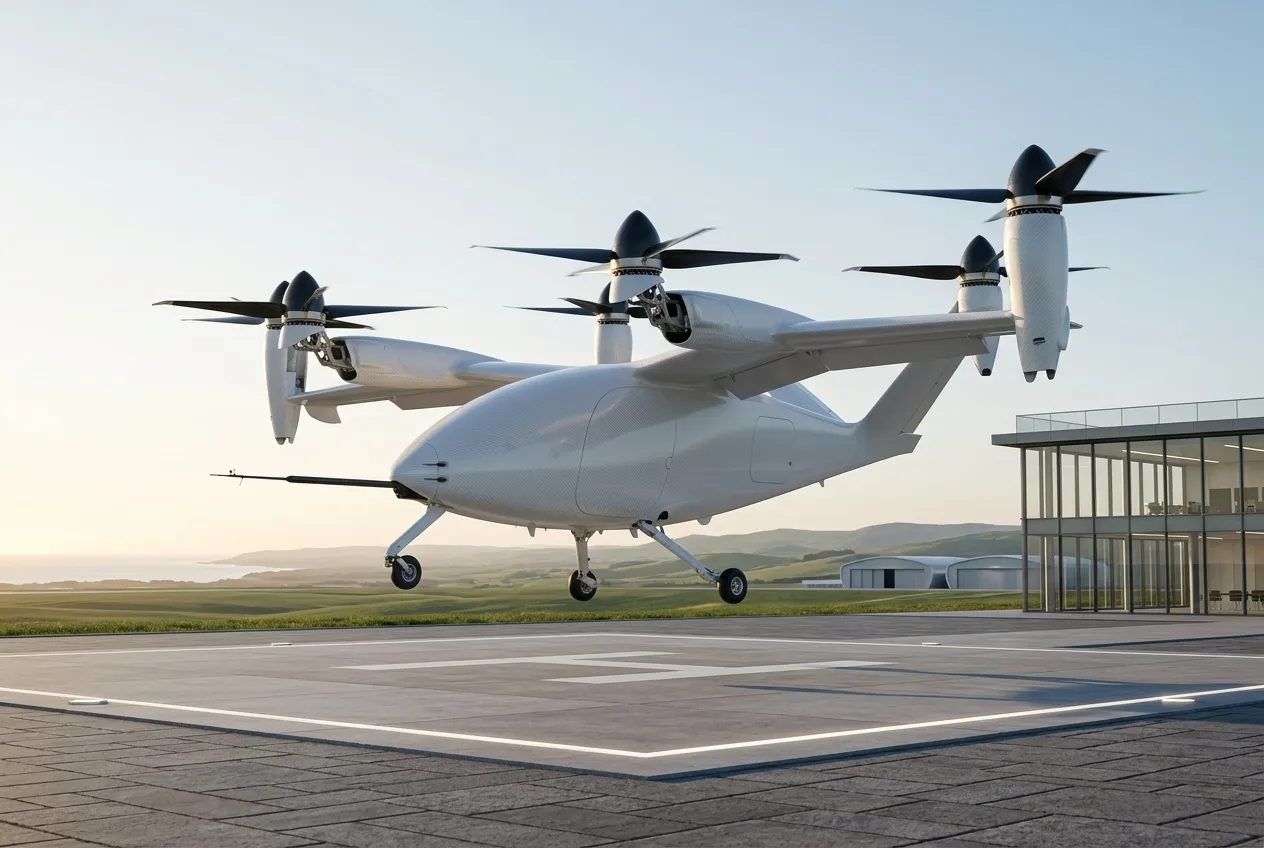
The aircraft in question is a hybrid variant of Joby’s well-known S4 platform. It introduces a turbine-electric system designed to extend range significantly beyond traditional battery-only limits. This marks a crucial evolution, as pure electric eVTOL aircraft have always faced one major constraint: range. The hybrid approach directly addresses that limitation without abandoning the advantages of electric propulsion.
Key advancements include:
- A turbine generator that supplements battery power
- A shift toward long-endurance missions
- Integration of autonomous flight systems (SuperPilot)
- A configuration likely designed for uncrewed operation
In simple terms: The aircraft is no longer constrained by batteries alone—it can now sustain flight using onboard energy generation.
Why Hybrid Propulsion Changes Everything
Electric aviation has always promised lower operating costs, reduced emissions, and lower noise. But it has struggled with energy density limitations, range constraints, and payload compromises. The hybrid model changes this balance. Instead of relying purely on stored energy, the aircraft generates power in flight—effectively turning a limitation into an operational advantage.
The Strategic Impact
This single shift opens up entirely new use cases:
- Long-range reconnaissance
- Regional air mobility
- Emergency response operations
- Military support missions
It also removes one of the biggest commercial barriers: Range anxiety in aviation. Just as hybrid vehicles bridged the gap in automotive electrification, hybrid eVTOL aircraft may well be the transitional architecture that enables widespread adoption.
From Air Taxi to Multi-Role Platform
Originally, Joby’s S4 aircraft was conceived as an urban air taxi—capable of carrying a pilot and four passengers over relatively short distances. That vision remains intact. However, what we are now seeing is something far more significant: A transformation from single-purpose vehicle to multi-role platform.
Civilian Applications
- Urban air mobility (airport transfers, city transport)
- Regional connectivity between smaller centres
- VIP and executive transport
Commercial Applications
- Logistics and high-value cargo delivery
- Offshore transport
- Remote area servicing
Military Applications
The hybrid variant is clearly being positioned for defence use, including autonomous reconnaissance, communications relay, and “loyal wingman” support roles. This diversification is not accidental. It reflects a broader strategy: Build one core platform—and adapt it across multiple high-value markets.
Autonomy: The Quiet Revolution
Perhaps the most profound aspect of this aircraft is not the propulsion system. It is the autonomy. The integration of Joby’s SuperPilot system suggests a future where aircraft navigate independently, optimise flight paths in real time, and manage complex missions without human input. This is not science fiction; it is already being tested.
Why This Matters
Autonomy changes the economics of aviation by removing pilot constraints, enabling 24/7 operations, reducing human error, and scaling far more efficiently. In practical terms, this means a fleet of autonomous aircraft could operate like a distributed aerial network, rather than individual vehicles.
The Design Philosophy: Simplicity with Purpose
The Joby platform follows a disciplined engineering approach, utilising six tilt rotors, distributed electric propulsion, a fixed wing for efficient cruise, and vertical take-off capability. This combination delivers helicopter-like flexibility with airplane-like efficiency. The result is a machine that avoids the compromises of both traditional aircraft types.
Key Advantage
Unlike helicopters, the platform offers lower noise, lower maintenance complexity, and higher efficiency in forward flight. Unlike fixed-wing aircraft, it requires no runway and possesses the ability to operate in confined spaces. This dual capability is the essence of the eVTOL revolution.
Range: The Defining Limitation—Now Being Solved
The standard S4 platform offers a range of approximately 161 kilometres (100 miles). That is sufficient for urban transport—but not much else. However, hybrid and hydrogen variants have already demonstrated dramatically extended range—over 800 kilometres (500 miles) in some configurations. This is the real breakthrough.
Why Range Matters
Range determines market viability, operational flexibility, and revenue potential. Without range, eVTOL remains a niche. With range, it becomes a true aviation alternative.
Global Momentum: A Race Now Underway
The development of eVTOL aircraft is no longer isolated; it is part of a global shift toward advanced air mobility. Regions such as the Middle East are already investing heavily in infrastructure, with expectations of operational deployments as early as 2026. Meanwhile, regulatory frameworks are evolving, certification pathways are being defined, and infrastructure (vertiports) is being planned. This is not speculative; it is moving toward commercial reality.
Economics: The True Disruptor
Technology alone does not change industries. Economics does. eVTOL aircraft—particularly hybrid and autonomous variants—offer the potential for lower operating costs than helicopters, reduced maintenance through fewer moving parts, and scalable fleet operations.
The Bigger Picture
When autonomy and electrification combine, labour costs decrease, utilisation rates increase, and pricing becomes more competitive. This creates a scenario where air transport becomes accessible to a far broader market.
The Defence Dimension: A Quiet But Critical Driver
While much public attention focuses on air taxis, the defence sector is likely to be the early adopter of hybrid eVTOL technology. The value proposition is immediate: long endurance, low acoustic signature, autonomous capability, and rapid deployment. The collaboration between Joby and defence contractors highlights this direction. Historically, many aviation breakthroughs have followed this path: Military first, commercial later.
Challenges That Remain
Despite the progress, several hurdles remain, including the complexity of regulatory approval and the necessity for vertiports and charging systems to be developed. Public acceptance regarding noise, safety, and reliability must also be proven. Furthermore, even with hybrid systems, battery energy density remains a limiting factor. These are not trivial challenges, but they are being actively addressed.
Where This Is Heading
The trajectory is clear. Over the next decade, we can expect hybrid systems to dominate early adoption, followed by a gradual transition to fully electric and hydrogen systems. We will see increasing levels of autonomy and expansion beyond urban environments. Ultimately, eVTOL aircraft will not replace traditional aviation; they will complement it, filling the gaps between ground transport, helicopters, and fixed-wing aircraft.
The Broader Implication: A New Layer of Transport
What Joby and others are building is not just a new aircraft. It is a new layer of transportation—one that operates below commercial airliners but above ground traffic. This “third layer” has enormous implications, including reduced congestion, faster regional connectivity, and new economic opportunities.
Conclusion: A Practical Future, Not a Concept
For years, eVTOL aircraft were treated as futuristic concepts. That phase is over. The hybrid Joby platform demonstrates real engineering progress, real flight capability, and real commercial and military interest. This is no longer about what might happen; it is about what is already underway. And, as history has shown, once aviation reaches this point, adoption is not a question of if—but when.
Final Thought
In the traditional world of aviation, progress has always been steady, measured, and deliberate. This development follows that same pattern. But beneath the surface, something far more significant is occurring: A quiet transformation that will reshape how we move—not just across cities, but across entire regions.