
In a world-first that marks a massive turning point for autonomous tech, an unmanned drone boat has successfully rescued two US Army crew members after their AH-64 Apache helicopter went down off the coast of Oman.
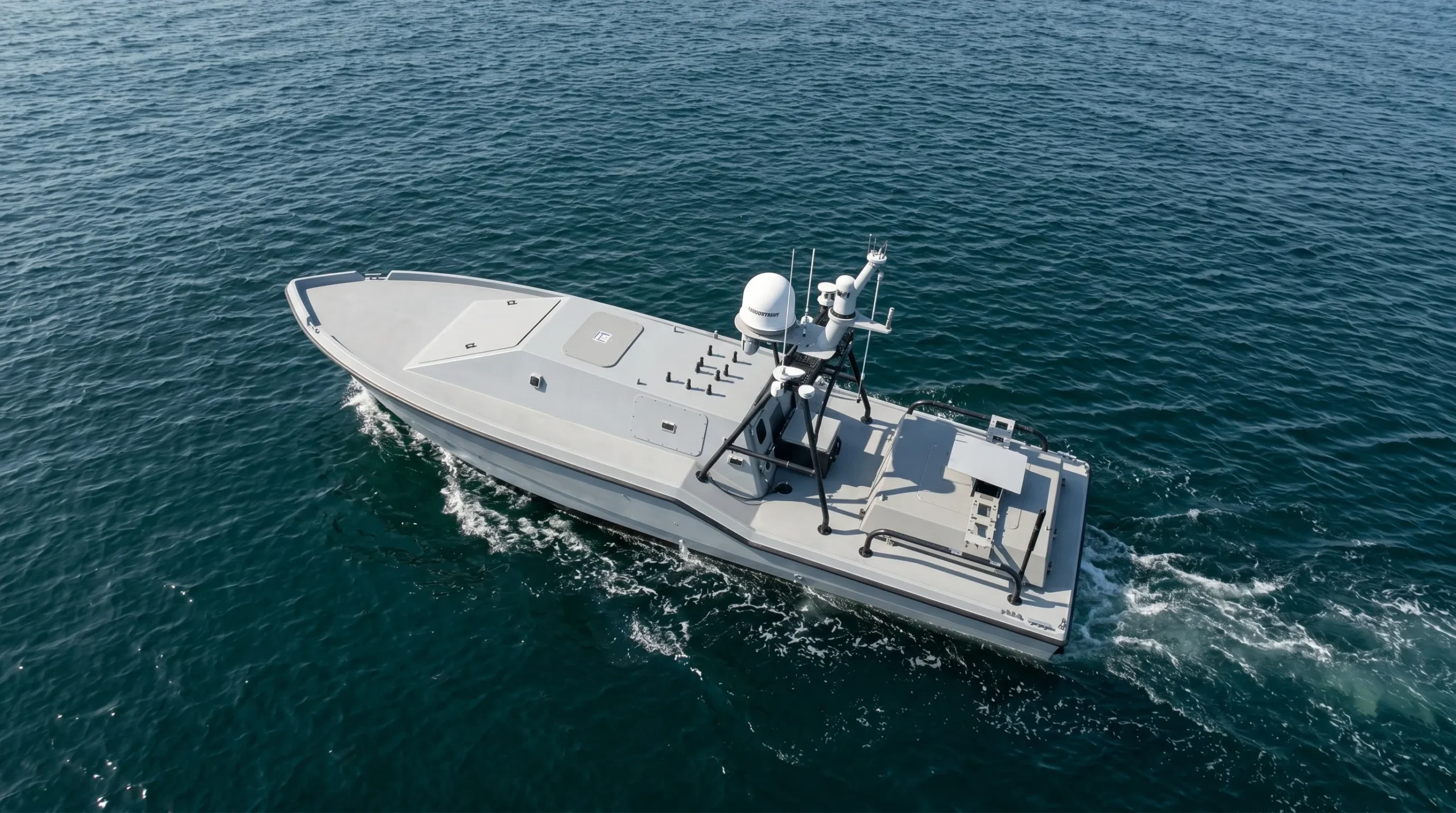
The rapid recovery—completed in under two hours—was pulled off by a US Navy ‘Corsair’ drone vessel, operated by the 5th Fleet’s forward-thinking Task Force 59.
While the exact details of why the Apache attack helicopter went down near the volatile Strait of Hormuz on June 8, 2026, are still being analysed, the real story is how they got out. Following a coordinated distress response from US Naval Forces Command and the 82nd Airborne Division, it wasn’t a traditional manned lifeboat that reached them first. It was an AI-driven, electric-propulsion-capable surface craft.
Inside the Two-Hour Extraction
Task Force 59 operates as a dedicated integration unit for artificial intelligence and unmanned systems, managing a fleet of next-gen drone boats. The hero of the day, the Saronic Corsair, is a 7.3-metre (24-foot) autonomous vessel packed with a 360-degree passive sensing payload.
Using its advanced tech suite, the Corsair autonomously located the two crew members in the water. The aviators were able to climb aboard the drone’s superstructure, which safely carried them to a designated extraction zone for a subsequent helicopter lift. Both crew members are reportedly in a stable condition.
Timeline of Events – June 8, 2026
- 11:33 GMT: Apache helicopter encounters trouble near the Strait of Hormuz.
- Task Force 59 dispatches the autonomous Saronic Corsair.
- Corsair uses 360-degree sensors to locate the crew in open water.
- Crew boards the 7.3m vessel; transported to safety within two hours.
Rewriting the Rules of Medical Evacuation
This historic milestone proves that autonomous platforms are no longer just for surveillance or logistics—they are highly capable lifesavers.
Historically, casualty evacuation (CASEVAC) has been one of the most resource-intensive and high-risk challenges for modern militaries bound by the principle of leaving no one behind. Traditional extraction is a numbers game: moving a single wounded soldier generally takes at least two able-bodied personnel out of the fight.
Worse still, adversaries have historically capitalised on this. During the Vietnam War, guerrilla forces purposefully wounded soldiers to halt American advances, knowing the entire unit would stop to manage the casualty. By the Falklands War, the British military adapted by treating casualties on the spot and pressing ahead with the assault, delaying full recovery until the area was secure.
Autonomous land, sea, and air drones completely shift this dynamic. By outsourcing high-risk recoveries to uncrewed vehicles, militaries can:
- Keep boots on the ground: Free up vital personnel to maintain operational focus.
- Protect the ‘Golden Hour’: Speed up the critical sixty-minute window where rapid medical intervention means the difference between life and death.
- Go where humans can’t: Send autonomous craft into high-threat environments or heavily defended zones without risking more lives.
Beyond the Battlefield: Implications for Australia and Global Disaster Relief
While this test case was military, the implications for civilian disaster relief—especially for a country like Australia—are profound.
As climate events become more severe, autonomous recovery drones could be deployed into hazardous zones left behind by bushfires, severe floods, cyclones, or earthquakes. Because these vessels can operate without risking a human crew, they can be pre-positioned in high-risk coastal or regional areas ahead of a predicted disaster, ready to drop off emergency supplies or evacuate stranded residents at a moment’s notice.
The Apache rescue also highlighted another crucial factor: flexibility. The Corsair wasn’t a purpose-built ambulance; it was simply a reliable autonomous platform pressed into service because it could carry a human-sized payload.
Looking ahead, we aren’t just talking about drone boats. Autonomous quadruped robots (think robotic mules) could be deployed to remote Australian terrain, functioning like high-tech St. Bernards to deliver medical supplies to stranded hikers. Similarly, humanoids currently under development could easily be reprogrammed from logistics roles to casualty transport duties.
The day when a call for medical help is answered by an autonomous system clad in high-vis or camo is no longer science fiction. It just happened in the ocean off Oman, and it’s a glimpse into a much safer, automated future.